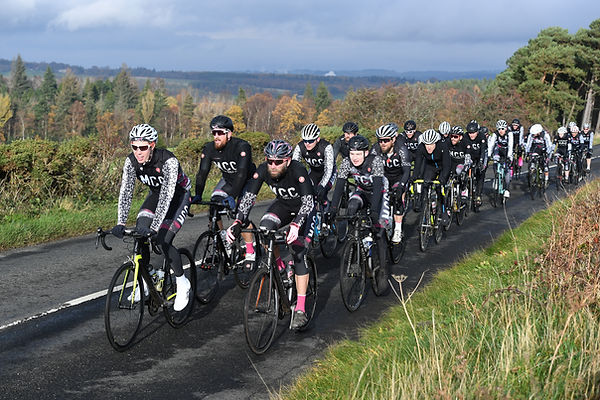
Our Riding Etiquette
Riding in a group is one of the best parts of being in this club. It’s social, it’s fast, and when done properly, it’s safe.
This guide isn’t about slowing things down or taking the fun out of riding. It’s about setting a clear standard so we all ride confidently, predictably and fairly. Especially when in built-up areas and on busier roads. Out in the lanes, the pace and flow can be as lively as ever, but when traffic is around, this helps us show the right example and keep everyone safe.
We have rights on the road, but we also share it. Let’s show the kind of cycling community we want to see, confident, organised and pleasant.
A smile or wave goes a long way. We want drivers, walkers and other riders to think, “that’s a good bunch of cyclists and a club I would like to be a part of.”
1. Our Philosophy
We ride fast and safely as a group. Everyone gets home. Everyone gets better.
We respect that the road is a shared space.
We have every right to use it, and we expect that right to be respected.
In return, we ride in a way that earns respect - predictable, polite, and representative of the club.
2. Ride Leadership
Unless otherwise agreed, the person who created the route is the Ride Leader. They set the tone, pace and structure of the ride.
● More experienced riders should offer guidance, especially when newer members join.
● Before rolling out, a quick reminder of group etiquette helps everyone start on the same page.
● If there’s a change in plan (route, pace or structure), make sure it’s communicated clearly down the line.
3. General Etiquette
Look after your club mates
Keep an eye on the group. Glance back now and then to make sure everyone’s still together. If someone’s dropped, ease off the pace until the group reforms. Don’t half wheel on the front, maintain the speed, don’t increase it. Stronger? Ride longer, not faster.
Pick the right ride
Join the ride that suits your fitness and experience. There’s no shame in choosing a steadier pace, it keeps the whole group safer and more enjoyable.
Be friendly
Contrary to popular North East rumour, we are good at this! Wave to other riders. Say hello. Good cycling manners go a long way, and we’ve built a good reputation recently by being approachable and polite, let’s keep it that way.
Be on time
Club rides leave at the stated time. Turning up late delays the whole group and breaks the rhythm. Arrive ready to roll, tyres pumped, bottles filled, and route loaded.
Be on a working bike
Make sure your bike is in good mechanical condition. Brakes, gears, tyres and lights should all be working properly. A well-maintained bike keeps you and everyone around you safe. Bring spares.
Hold your line through a corner
No wobbling.
No freewheeling while on the front.
Ride a solid tempo so those behind aren't coasting. If you’re doing 100w the riders at the back are getting cold.
4. Communication
Communication keeps the group safe and smooth. Use hand signals as much as possible: four fingers up like an indicator to show an obstacle on your left or right. Motion your arm behind your back if a rider needs to move in or out. Double flick of the elbows if you’re about to stand on the pedals. Less shouting means a calm group. Pay attention to the rider in front.
Common calls used in emergency situations - there is no need to call out every car or crack in the road unless it is dangerous
● Car up– Vehicle approaching from the front.
● Car back – Vehicle approaching from behind.
● Stopping
● Single out – Move safely into single file when needed.
● Use clear hand signals and pass messages along the line.
● If you’re the last rider, call “last ” when the road is clear so others know when it’s safe to move back in.
5. Rotating and Group Riding Technique
Rotations should be smooth and structured. No parting of the Red Sea with 2 riders peeling off to drift to the back, no big gaps opening up. The goal is to keep a tidy, efficient line that works like a machine.
When your turn on the front is done, communicate with your partner, rotate smoothly either to the left or the right depending on the wind. The rider leader can determine this and communicate to the group.
No need for hero pulls —the goal is a smooth rotation without dropping anyone off the back. A smooth group is a fast group.
Once you’ve rotated twice, you’ll find yourself back in shelter and ready to go again. This also allows you to speak to different people down the line.
On quiet roads with perfect visibility there’s a little more flexibility — but the default is to rotate like a chaingang.
6. Winter Riding
When the weather turns grim, preparation makes all the difference.
● Lights: Mandatory after dark and strongly recommended even during the day.
● Mudguards: If you’re riding with others, fit them. No one likes a wheel spray shower.
● Tools and spares: Bring enough to fix common issues. Don’t leave anyone stranded on a freezing verge.
● Clothing: Dress for the conditions. Being tough doesn’t mean being cold and miserable. Extra layer for the cafe stop is always a good idea too.
● Fuel appropriately for the ride - bring snacks
7. Final Reminders
● Don't be afraid to give feedback to anyone, old guard or new. Nobody is perfect.
● Single out on tight or narrow roads when cars are approaching, we share the space, not own it.
● No parting the red seas on the front, it's never safe to be 4 a breast with 2 riders drifting backwards.
● Respect ride leaders and fellow riders.
● Communicate clearly and kindly.
● Be predictable, steady and safe.
● Have the route loaded before you start.
Above all, enjoy it. We ride because we love it. When we do it right, everyone benefits.